



James Stockdale: The Responsibility of Being Strong
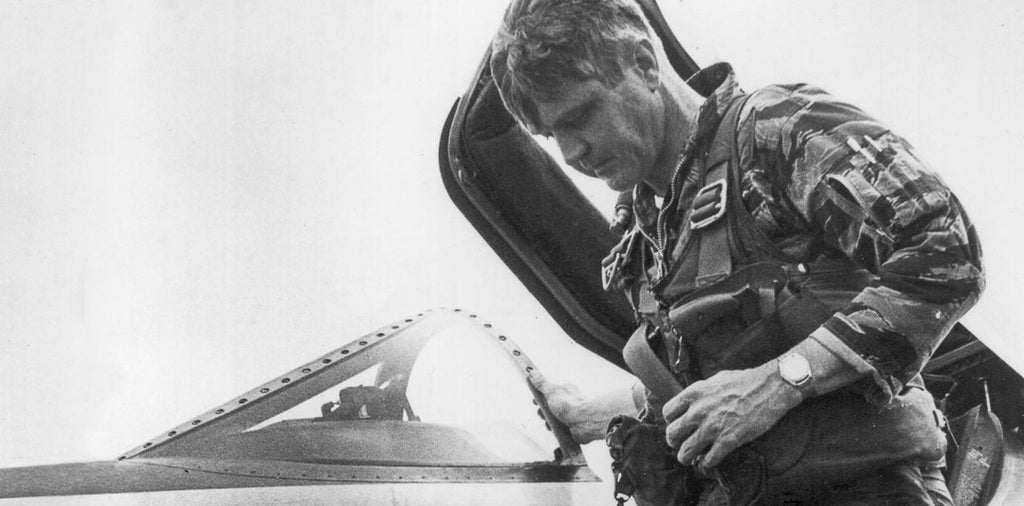
On September 9, 1965, Navy Commander James Stockdale was flying an A-4 Skyhawk over North Vietnam when his aircraft was struck by enemy fire.
He ejected and was captured.
The naval aviator who had commanded men and aircraft from the deck of an American carrier was suddenly a prisoner, injured and facing an uncertain future.
He would spend the next seven and a half years in captivity.
During that time, Stockdale would endure repeated torture, prolonged isolation, and attempts to force him into making propaganda statements.
But he would also become one of the most important leaders among the American prisoners of war.
His authority no longer came from an aircraft, a uniform, or the freedom to issue orders.
It came from the example he was willing to set.
Prepared Before the Test
Stockdale was born in Abingdon, Illinois, in 1923.
He graduated from the United States Naval Academy in 1947 and became a naval aviator, eventually serving as a fighter pilot, test pilot, and commanding officer.
In the early 1960s, the Navy sent him to Stanford University, where he earned a master's degree in international relations.
During those years, Stockdale developed a serious interest in the ancient Stoic philosopher Epictetus.
The philosopher's teachings emphasized a distinction that would become central to Stockdale's life: some things are within our control, while others are not.
A person may not be able to control circumstances, the actions of others, or the outcome of events.
But he remains responsible for his own judgments and choices.
For Stockdale, these ideas were more than an academic interest.
They became a framework for confronting fear, uncertainty, and hardship.
When his aircraft was shot down in 1965, he entered captivity carrying an understanding of responsibility that had been developed long before the moment he needed it.
The United States Naval Academy's Stockdale Center for Ethical Leadership preserves his story and the philosophy that informed his leadership.
Leadership Without Freedom
Stockdale was imprisoned at Hoa Lo Prison in Hanoi, known among American prisoners as the Hanoi Hilton.
As the senior American naval officer in captivity, he assumed responsibility for helping organize resistance among fellow prisoners.
The conditions were severe.
Prisoners faced isolation, physical abuse, and efforts to extract statements that could be used for propaganda.
Communication was restricted and often dangerous.
Yet Stockdale and other prisoners developed ways to communicate, maintain discipline, and support one another.
Their efforts helped preserve a sense of order and shared purpose in circumstances designed to break both.
Stockdale understood that leadership required more than demanding endurance from others.
He also had to consider what men could realistically withstand.
The prisoners faced impossible choices under torture, and Stockdale sought to establish expectations that recognized human limits while preserving their commitment to one another.
He knew that a man who had been forced beyond his endurance should not be abandoned by the men beside him.
This was leadership stripped to its essentials.
There were no comfortable offices, no public recognition, and no assurance that anyone outside the prison would ever know what had taken place.
There were only decisions, consequences, and people depending on one another.
The Cost of Holding a Standard
Stockdale's resistance brought extraordinary suffering.
His captors recognized his role in organizing the prisoners and repeatedly subjected him to severe punishment.
He spent years in isolation and restraints.
In September 1969, facing renewed interrogation and fearing further punishment of other prisoners, Stockdale took an extreme action that placed his own life in danger rather than submit to his captors' demands.
His actions helped convince his captors to reduce some of their harsh treatment of American prisoners.
The episode became central to the official recognition of his courage.
In 1976, President Gerald Ford presented Stockdale with the Medal of Honor.
The Congressional Medal of Honor Society's account documents the circumstances of the award and the extraordinary risks he accepted.
The distinction recognized more than his willingness to endure suffering.
It recognized his leadership and his commitment to fellow prisoners under conditions few people will ever experience.
Stockdale's example should not be simplified into the idea that courage means never feeling fear or never reaching a breaking point.
His experience demonstrated something more difficult.
He understood human vulnerability.
And he continued to accept responsibility for others despite his own.
The People Waiting at Home
While Stockdale was imprisoned, his wife, Sybil, faced a different responsibility.
She was raising their four sons while confronting uncertainty about her husband's survival and treatment.
Rather than remain silent, she helped organize families of American prisoners of war and those missing in action.
Her efforts contributed to the formation of the National League of Families of American Prisoners and Missing in Southeast Asia.
She advocated for greater attention to the prisoners and their treatment.
The work required determination of its own.
James Stockdale's story cannot be separated from hers.
While he worked to sustain the men in captivity, Sybil worked to ensure that those men were not forgotten.
In 1984, the couple published In Love and War, recounting their experiences during those years.
Their shared history reminds us that responsibility is not always exercised in the same place or in the same way.
Sometimes it means standing beside someone.
Sometimes it means working for them when they cannot speak for themselves.
What Strength Is For
Stockdale was released from captivity on February 12, 1973.
He returned to naval service, eventually retiring as a vice admiral.
In the years that followed, he continued writing and speaking about leadership, ethics, and the philosophy that had helped sustain him.
His influence extended beyond military service.
The Navy established the Vice Admiral James Bond Stockdale Award for Inspirational Leadership, recognizing officers whose conduct reflects exceptional leadership.
His experiences also became an enduring subject of study for those interested in courage, judgment, and responsibility.
James Stockdale died in 2005.
His military decorations tell part of his story.
His years as a prisoner tell another.
But perhaps the most important part is what he believed leadership required.
He could not remove the suffering of the men around him.
He could not promise them when they would return home.
He could not control the actions of their captors.
What he could do was help establish a standard, share the burden, and refuse to treat the fate of others as separate from his own.
That is a demanding understanding of strength.
Not strength used to establish superiority.
Not strength displayed for recognition.
But strength placed in the service of people who are counting on it.
James Stockdale's life offers a reminder that character is not measured only by what a person can endure.
It is also measured by what he chooses to protect.