


Philippe Dufour: The Man Who Would Not Compromise
In a small Swiss village in the Vallée de Joux, Philippe Dufour has spent much of his working life doing something that the modern world rarely encourages.
Taking his time.
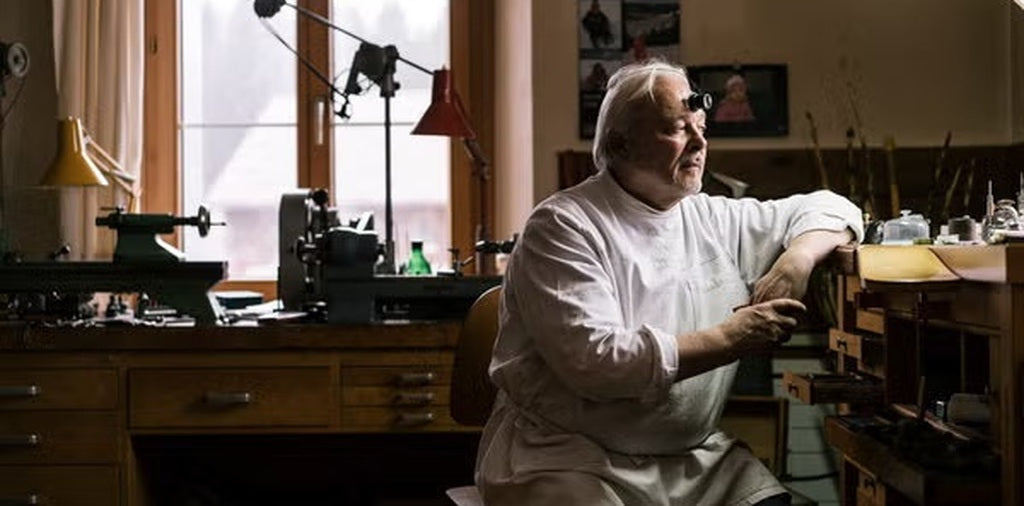
At his watchmaking bench, surrounded by small tools and mechanical components, he works on details that most people will never see.
A steel surface polished until it reflects light cleanly. The precise edge of a bridge inside a movement. A tiny component finished by hand, even though it will spend its working life hidden behind a watch dial.
None of these details makes the watch tell time more accurately simply by being beautiful.
But to Dufour, they are part of making the watch properly.
He has become one of the most respected independent watchmakers in the world, not by producing large numbers of watches, but by making remarkably few.
His reputation rests on a simple idea.
If something is worth making, it is worth making well.
Learning the Work
Philippe Dufour was born in 1948 in Le Sentier, Switzerland, a village in the Vallée de Joux.
The region has been associated with fine mechanical watchmaking for generations. Workshops, specialist suppliers, and skilled craftspeople developed there around the demanding work of producing intricate watch movements.
Dufour entered watchmaking through an apprenticeship as a teenager.
He learned the fundamentals of a trade in which a fraction of a millimeter can determine whether a mechanism functions correctly.
Over the years, he worked for established manufacturers and gained experience with increasingly complicated movements.
His skills eventually took him into the specialized world of restoring antique watches and creating complex mechanisms.
Restoration taught him something that would remain central to his work.
The old watchmakers had solved difficult mechanical problems with hand tools, patience, and an intimate understanding of materials.
Their work could still be examined decades or centuries later.
And the quality of that work was often visible in places that the original owner might never have seen.
Dufour came to believe that these traditional methods were worth preserving.
Not simply because they were old.
Because they represented an extraordinary level of skill.
Mastering Complexity
In the 1980s, Dufour began developing a highly complicated pocket-watch movement capable of chiming the hours, quarters, and minutes.
Known as a grande sonnerie, the mechanism is among the most demanding achievements in traditional watchmaking.
It requires an intricate system of gears, springs, and striking components to work together reliably.
Dufour completed his first grande sonnerie pocket watch in 1982.
He later accomplished something that had not previously been achieved in a wristwatch: adapting a grande sonnerie mechanism to a wearable timepiece.
His Grande Sonnerie wristwatch debuted in 1992.
It established his reputation as a watchmaker capable of producing mechanisms that few others would attempt.
In 1996, he introduced the Duality, a wristwatch incorporating two independent balance wheels connected through a differential mechanism.
These were remarkable technical accomplishments.
But Dufour's next watch would move in a very different direction.
Rather than making another watch more complicated, he decided to concentrate on making one simpler.
The Discipline of Simplicity
In 2000, Dufour introduced the Simplicity.
It displayed the hours, minutes, and seconds.
No elaborate calendar.
No tourbillon.
No striking mechanism.
Just the essential functions of a mechanical wristwatch.
By conventional measures of mechanical complexity, it was far less ambitious than his earlier creations.
But that was not the point.
Dufour wanted to demonstrate what traditional watchmaking could achieve when extraordinary attention was given to the fundamentals.
The movement was constructed and finished with the same seriousness that another watchmaker might reserve for a grand complication.
Its bridges received careful hand finishing. Edges were shaped and polished. Decorative patterns were applied with precision.
Even the smallest visible details had to meet his expectations.
The Simplicity became a statement about craftsmanship without needing to announce itself.
Its restrained appearance gave little indication of the extraordinary work inside.
To someone unfamiliar with mechanical watches, it could appear almost ordinary.
To those who understood the craft, it represented something exceptional.
The Fondation de la Haute Horlogerie has recognized Dufour's place among the leading figures of independent watchmaking.
And the Simplicity has become one of the most admired expressions of his approach.
It is a watch whose distinction comes not from how much it does, but from how carefully it is made.
The Work Nobody Sees
There is a particular kind of discipline involved in finishing a mechanical watch by hand.
A surface may already function perfectly.
An edge may already fit.
A component may already perform its intended task.
The watchmaker could move on.
But traditional high-end finishing asks a different question.
Is the work complete to the standard the maker believes it deserves?
For Dufour, the answer cannot be determined solely by whether the mechanism works.
The quality of the craftsmanship matters in its own right.
That philosophy has practical consequences.
Hand-finishing takes time.
It requires specialized skills developed over years.
It limits how many watches a single craftsman can produce.
Dufour has never attempted to turn his workshop into a large manufacturing operation.
The scarcity of his watches is a consequence of the time and labor required to make them.
His approach also carries a responsibility to the craft itself.
Traditional skills can disappear when they are no longer practiced or taught.
Dufour has spoken about the importance of preserving these methods and passing knowledge to younger watchmakers.
His daughter Daniela has also worked in watchmaking, extending the family's connection to the trade.
The work is not simply about producing an object.
It is about preserving the ability to make it.
Knowing When Something Is Enough
The luxury watch industry often celebrates innovation, rarity, and technical achievement.
Those things can be meaningful.
But Dufour's career offers another way of understanding excellence.
He proved his ability to create extraordinary mechanical complexity.
Then he chose to devote himself to a watch that did very little beyond telling the time.
That decision was not a retreat from ambition.
It was a different expression of it.
The Simplicity demanded confidence in the fundamentals.
There was no complicated mechanism to draw attention away from the finishing.
No unusual display to serve as the centerpiece.
The quality of the work had to speak for itself.
For more than five decades, Dufour has pursued a standard that cannot be reached quickly.
His watches are valued by collectors around the world, but the most revealing part of his story is not their market price.
It is the way he approaches the bench.
The willingness to repeat a task until it is right.
The patience to improve something that already works.
The refusal to overlook a detail simply because the customer may never notice it.
Philippe Dufour's life in watchmaking reminds us that simplicity is not necessarily the absence of difficulty.
Sometimes it is the result of mastering that difficulty so completely that nothing unnecessary remains.
And sometimes the clearest expression of a craftsman's ability is knowing when he has done enough—and refusing to stop before then.