



James E. Casey: The Man Who Built on Trust
A Hundred Dollars and a Promise
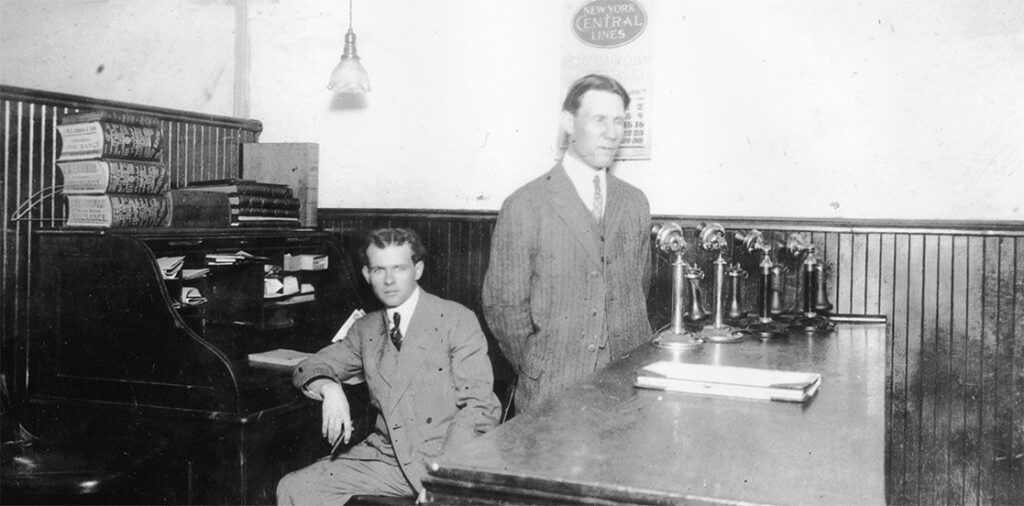
In 1907, a nineteen-year-old named James E. Casey opened a small messenger service in Seattle, Washington, with his friend Claude Ryan.
They had borrowed $100 to get started.
Their office was in a basement. Their equipment was modest. They had no fleet of trucks, no national network, and little reason to imagine that the business would one day become one of the most recognizable companies in the world.
They called it the American Messenger Company.
Seattle was growing quickly, and reliable communication was becoming increasingly important. Messages, packages, and documents still needed to move from one person to another, often by bicycle or on foot.
Casey understood the opportunity. But the business would depend on something more fundamental than transportation.
Someone had to trust that when a messenger accepted a responsibility, the job would get done.
The young company grew by providing a service people could depend upon. What began in a Seattle basement would eventually become United Parcel Service.
The beginning was small.
The responsibility was not.
The Discipline of Dependability
As the company expanded, Casey faced a challenge familiar to anyone who has built a business.
How do you maintain the quality of a service when you can no longer personally oversee every detail?
For a messenger company, the answer mattered enormously. A delivery was not simply an exchange of goods. It was a promise made to one person on behalf of another.
That promise had to survive distance, growth, changing employees, and the ordinary complications of a working day.
The company evolved from delivering messages to handling packages for merchants. In 1919, its expansion beyond Seattle brought the name United Parcel Service.
Over time, the operation became larger and more sophisticated. But its success continued to depend on countless individual decisions: arriving when expected, handling a package properly, solving a problem, and completing the work.
Casey's approach was grounded in the belief that dependable service required more than a good system. It required people who understood their responsibilities.
That philosophy became part of the company's identity. In its published business principles, UPS emphasized the importance of making promises carefully and honoring them.
There is nothing particularly glamorous about consistency.
But consistency, practiced long enough, becomes a reputation.
And a reputation for doing what you say you will do can become one of the most valuable things a business owns.
Building With People
Casey understood that a growing company could not depend on the determination of one man.
Its future would rest with the people doing the work.
He became an advocate for employee ownership, advancement from within, and treating workers as participants in the enterprise rather than simply as hired hands.
He wanted people to take responsibility for their departments and operations with the judgment and commitment of an owner.
It was a practical approach to leadership. When employees had an opportunity to share in the company's success, they also had a reason to care deeply about its performance.
Casey's commitment to employee ownership became one of the defining features of his leadership.
The United States Department of Labor, which inducted him into its Hall of Honor, recognized his emphasis on fair treatment, promotion from within, employee ownership, and cooperation with organized labor.
These were not always easy principles to maintain through economic uncertainty and decades of expansion.
But Casey believed that the people who built a company should have an opportunity to benefit from what they helped create.
There is an important distinction between building a successful business and building an organization capable of succeeding beyond its founder.
The first requires ambition and ability.
The second requires trust in other people.
What He Built Beyond Business
Long before James Casey became a successful businessman, he understood what it meant for a family to face uncertainty.
His father died when Casey was young. His mother, Annie E. Casey, raised four children, and Jim went to work early to help support the household.
The experience remained part of his family's story.
In 1948, Casey and his siblings established the Annie E. Casey Foundation in honor of their mother.
Their purpose was to help children and families facing difficult circumstances.
The foundation's earliest work included supporting a camp for disadvantaged children near Seattle. Over time, its efforts expanded into a lasting commitment to improving opportunities for young people and strengthening families.
It was a different kind of undertaking from building a delivery company.
Yet both grew from an understanding of responsibility.
One involved earning the confidence of customers and employees. The other involved recognizing the needs of children and families whose circumstances made opportunity harder to reach.
Casey died in 1983 at the age of ninety-five.
By then, the small messenger service he had helped establish had become a major American enterprise. His family's philanthropic work would continue beyond his lifetime.
His story began with a borrowed hundred dollars and the determination to build something of his own.
What makes it worth remembering is not simply how large that business became.
It is the understanding that a man's work can create opportunities for people he may never meet.
And that the things he builds can continue serving others long after his own work is done.