


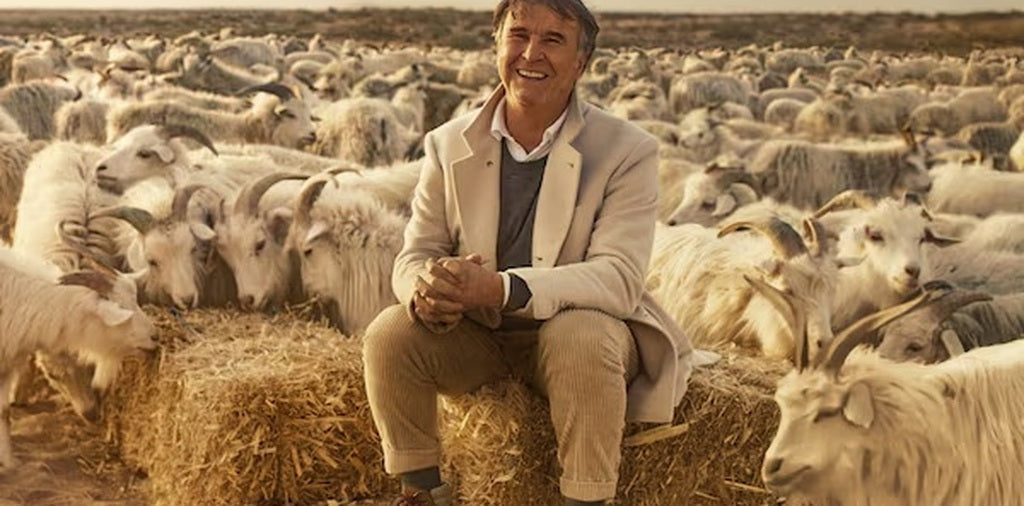
Brunello Cucinelli: The Dignity of Making Things Well
Long before Brunello Cucinelli became known for some of the world's finest cashmere, he was a young boy growing up in the Italian countryside.
His family worked the land near Perugia. Life was modest, and the value of work was understood from an early age.
When his father left farming for a factory job, the family gained comforts they had never known.
But Brunello also witnessed something that stayed with him.
His father was unhappy with the way he was treated at work.
As Cucinelli recounts in his personal biography, those experiences helped shape his belief that work should respect human dignity.
Years later, when Brunello began building a company of his own, he carried a conviction shaped by those experiences: a business should provide more than a living. It should respect the people whose work makes its success possible.
That belief would become as important to his company as the clothing it produced.
The Beginning Was a Sweater
In 1978, at 25 years old, Cucinelli started a small business with an idea that was unusual for its time.
He wanted to make colorful cashmere sweaters for women.
Cashmere was already associated with quality, but its traditional presentation was often conservative. Cucinelli believed that color could give the material a different character while preserving its craftsmanship.
It was a simple idea that required considerable faith.
He did not begin with an established fashion house or a large manufacturing operation. He began with a product he believed could be made differently.
The business gradually found customers.
As it grew, so did his understanding of what he wanted the company to represent.
The quality of a garment mattered. The people making it mattered. The place where the work happened mattered.
For Cucinelli, those ideas were connected.
A beautiful finished product could not be separated from the conditions under which it was created.
A Village Worth Preserving
In 1982, Cucinelli married Federica Benda, whose family came from Solomeo, a small medieval village in the hills of Umbria.
He had come to know the village while visiting her during their courtship.
Its buildings and surroundings held a history that he believed deserved to be preserved.
In 1985, he purchased the village's deteriorating medieval castle and established his company's headquarters there.
What began as a business decision became something larger.
Over the following decades, Cucinelli supported the restoration of historic buildings and the development of spaces dedicated to culture, education, and community life.
The work included a theater, an amphitheater, and gardens.
As the business expanded, former industrial buildings in the valley were adapted for production rather than simply replacing the landscape with new construction.
The transformation of Solomeo, the Hamlet of Cashmere and Harmony, became an expression of his belief that commercial success could help preserve a community's character.
The buildings were restored for continued use.
The village's history was treated as something worth carrying forward.
And the people who worked there remained central to the story.
The Hands Behind the Work
Cucinelli describes his business philosophy as humanistic capitalism.
At its center is the belief that a company can pursue financial success while respecting the moral and economic dignity of its workers.
He has advocated fair compensation, reasonable working hours, and workplaces designed with consideration for the people who spend their days in them.
These are principles he has publicly championed and sought to express through his company's operations.
They also reflect a larger concern about the future of skilled work.
Fine knitwear depends on knowledge developed through years of practice.
The quality of a finished garment can be influenced by decisions that most customers will never see.
The selection of yarn.
The handling of the material.
The precision of a seam.
The judgment of the person who knows when something is right—and when it needs more work.
In 2013, Cucinelli established a school dedicated to contemporary arts and crafts in Solomeo.
Today, the Solomeo Schools of Style and High Craftsmanship reflect that commitment to preserving and passing along specialized skills.
The school represented an investment not only in production, but in the people who would carry those skills into the future.
A craft survives when someone takes the time to teach it.
And someone else believes it is worth learning.
What Success Makes Possible
In time, the small cashmere business became an international fashion company.
Its growth brought commercial success, recognition, and influence far beyond the hills of Umbria.
But Cucinelli continued to direct attention toward Solomeo.
Through his foundation and related initiatives, he supported further restoration and cultural projects intended to benefit the village and its surroundings.
These choices offer a different way to consider what a successful business can accomplish.
Profit makes expansion possible.
It can also make preservation possible.
A company can invest in buildings, equipment, and distribution.
It can also invest in education, skilled workers, and the community that gives the business its home.
Cucinelli's approach does not remove the ordinary pressures or contradictions of running a global luxury company.
But it offers a clearly stated ambition: that commercial achievement and consideration for people need not be opposing ideas.
That ambition has guided much of his life's work.
Something Worth Passing Along
There is a particular kind of satisfaction in making something well.
It comes from knowing the material, understanding the purpose, and giving the work the attention it deserves.
For a skilled craftsman, that satisfaction is not always visible to the person who receives the finished piece.
The customer may notice how a garment feels or how carefully it fits.
They may never know the name of the person who made it.
Yet the maker's knowledge is present in every detail.
Brunello Cucinelli built a company around beautiful clothing, but his story reaches beyond what hangs in a wardrobe.
It is also about a father's experience at work.
A village worth preserving.
A skill worth teaching.
And a belief that the people responsible for making something deserve as much consideration as the thing they make.
Perhaps that is the most lasting measure of good work.
Not simply what was created.
But what was respected, preserved, and passed along in the process.