

John W. Nordstrom: The Business of Treating People Well
In 1887, a 16-year-old boy arrived in New York from Sweden with five dollars in his pocket.
He spoke little English. He had no established business, no influential connections, and no certainty about what his future would hold.
His name was John W. Nordstrom.
Over the years that followed, he would work in logging camps, mines, and other demanding jobs as he made his way across America.
Eventually, he would help establish one of the country's most recognizable retail businesses.
But the most enduring part of his story is not the size of the company that bears his name.
It is the principle upon which that company was built.
A customer deserves to be treated well.
Five Dollars and a Willingness to Work
Nordstrom was born in Sweden in 1871.
At sixteen, he left home for the United States, beginning a journey that would take him across the country in search of opportunity.
He found work wherever he could.
The jobs were often physically demanding. He labored in mines and logging camps, gradually making his way west.
In 1897, news of gold discoveries drew him north to Alaska and the Klondike.
Like thousands of others, he hoped the gold fields might offer an opportunity to build a better future.
The work was difficult, and success was far from certain.
After two years, Nordstrom returned to Seattle with approximately $13,000 from his mining venture.
It was enough to begin considering a different kind of life.
He had spent years earning a living through physical labor.
Now he had an opportunity to build something of his own.
The journey from Sweden to Seattle is documented in Nordstrom's company history, which traces the beginnings of the business to those early years of work and determination.
A Small Store in Seattle
During his time in Alaska, Nordstrom had become acquainted with a shoemaker named Carl F. Wallin.
Wallin eventually offered him a partnership in a shoe business.
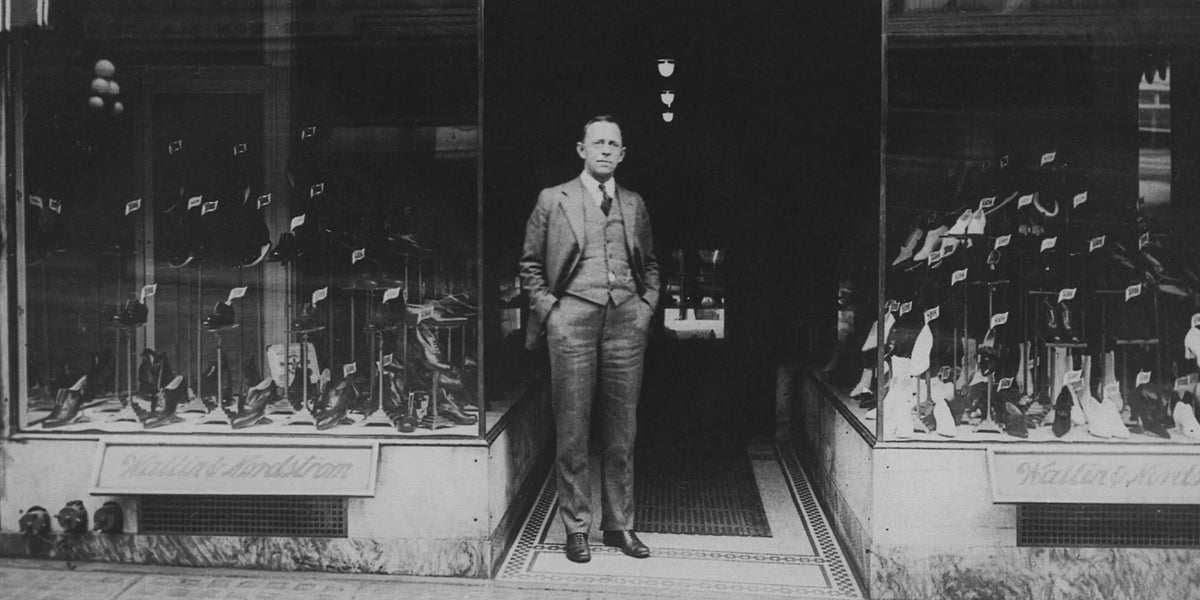
In 1901, the two men opened Wallin & Nordstrom at Fourth Avenue and Pike Street in Seattle.
It was a modest beginning.
The store was small, and the partners were entering a business where customers had choices.
They could compete on price, selection, convenience, or the quality of the shoes they offered.
But Nordstrom believed that lasting success required something more.
Customers needed to feel that the business was genuinely interested in serving them.
The company's founding philosophy emphasized service, selection, quality, and value.
Those were practical commitments.
A customer needed the right product.
The product needed to be worth the price.
And the experience of purchasing it needed to earn the customer's confidence.
The store gradually established itself in Seattle.
In 1923, the partners opened a second location in the city's University District.
What began as a single shoe shop was becoming a family business with a growing reputation.
The HistoryLink account of Nordstrom's early years documents the partnership, the first store, and the company's development in Seattle.
Service Is a Decision
There is a difference between completing a transaction and earning a customer's trust.
A transaction ends when the purchase is made.
Trust develops through what happens before, during, and after that moment.
Nordstrom's founding philosophy recognized the importance of that distinction.
Good service required employees to pay attention.
To understand what a customer needed.
To provide useful information.
And to treat the person standing in front of them as more than another sale.
These principles may appear ordinary.
But ordinary things, practiced consistently, are often what distinguish an exceptional business.
A customer remembers being listened to.
They remember when someone made an extra effort.
They remember whether a problem was handled with patience or indifference.
And they remember how they were treated when there was nothing more to purchase.
The business John Nordstrom helped establish became associated with a strong service culture, a reputation later generations of the company worked to develop and preserve.
As Nordstrom explains in its company overview, customer service has remained central to its identity since the first shoe store opened in 1901.
The lesson is larger than retail.
Whether someone manages a hotel, operates a restaurant, leads a team, or welcomes a guest into their home, the quality of the experience often depends on the attention given to another person.
Service is not simply a department.
It is a decision about how people deserve to be treated.
A Standard Passed Along
By the late 1920s, John Nordstrom was ready to step away from the business.
His sons Everett, Elmer, and Lloyd became increasingly involved in its operation.
In 1928, John retired and transferred his interest to the next generation.
The following year, Carl Wallin sold his share to the Nordstrom family.
The company continued to grow under the sons' leadership.
Over the following decades, it expanded beyond its original stores, eventually becoming a major American retailer.
Much of the business recognized today was developed long after John Nordstrom had retired.
That distinction matters.
He did not personally oversee every expansion, establish every later service practice, or build the modern company alone.
His contribution was the beginning.
He helped establish a business and a set of principles that others would carry forward.
The ability of a standard to outlast its founder may be one of the most meaningful measures of leadership.
A good business can survive a change in ownership.
A good principle can survive a change in generations.
But only when people continue choosing to practice it.
What People Remember
John W. Nordstrom died in 1963.
By then, the small Seattle shoe store he had opened more than sixty years earlier had become a substantial family enterprise.
The company would continue expanding into apparel and new markets, eventually reaching customers far beyond Washington.
Its growth is part of American retail history.
But the principle at the beginning of the story remains worth considering.
A young immigrant who had spent years doing difficult work chose to build a business around providing customers with quality, value, and good service.
He understood that a successful enterprise depended on people being willing to return.
And people are more likely to return when they believe they have been treated fairly and with consideration.
There will always be new ways to sell something.
New technology.
New stores.
New methods of reaching customers.
But the fundamental experience of being respected does not become outdated.
A customer may forget the price of a pair of shoes.
They may forget the name of the person who helped them.
But they are unlikely to forget how that person made them feel.
John Nordstrom built a business selling shoes.
The standard he helped establish was about something more enduring.
Treat people well.
Give them a reason to return.
And make sure the experience is worth remembering.